
A single-day tournament and a full esports league solve two different problems. A tournament gets you one moment of attention. A league gets you repeated attention, week after week, with a storyline that builds as the season goes on. Both are valid — but a lot of first-time organisers plan a league with a tournament's level of preparation, and then find out in week three why that doesn't work.
Start with the season format, not the schedule
Before a single match date goes on a calendar, the format needs to be settled: how many teams or players, how many weeks, round-robin versus group-and-playoffs, how ties are broken, and how many matches each competitor plays before standings start to mean anything. Get this wrong and you either end up with a season that's mathematically decided by week four, or one so long that interest drops off before the finale.
Standings are the product
In a tournament, the bracket is the story. In a league, the standings table is the product people check in on between match days — it's what makes a league feel alive even on weeks with no live match happening. A clear, visible, regularly updated standings system (points for a win, tiebreaker rules defined up front, head-to-head results tracked) is non-negotiable, and it needs to be decided before the season starts, not patched together after the first controversial result.
A tournament ends when the bracket does. A league only works if people have a reason to check back in between match days.
Scheduling across a season is a logistics problem, not a creative one
Match scheduling across a full season means coordinating venue availability, competitor availability, broadcast crew availability and — if the league is public-facing — audience expectations about when matches happen, all repeated weekly or bi-weekly for the length of the season. This is where leagues most often fall apart in practice: a single missed or rescheduled match day early in a season can cascade into fixture pile-ups by the end of it if there's no contingency plan built in from the start.
Broadcast production turns a league into something worth watching
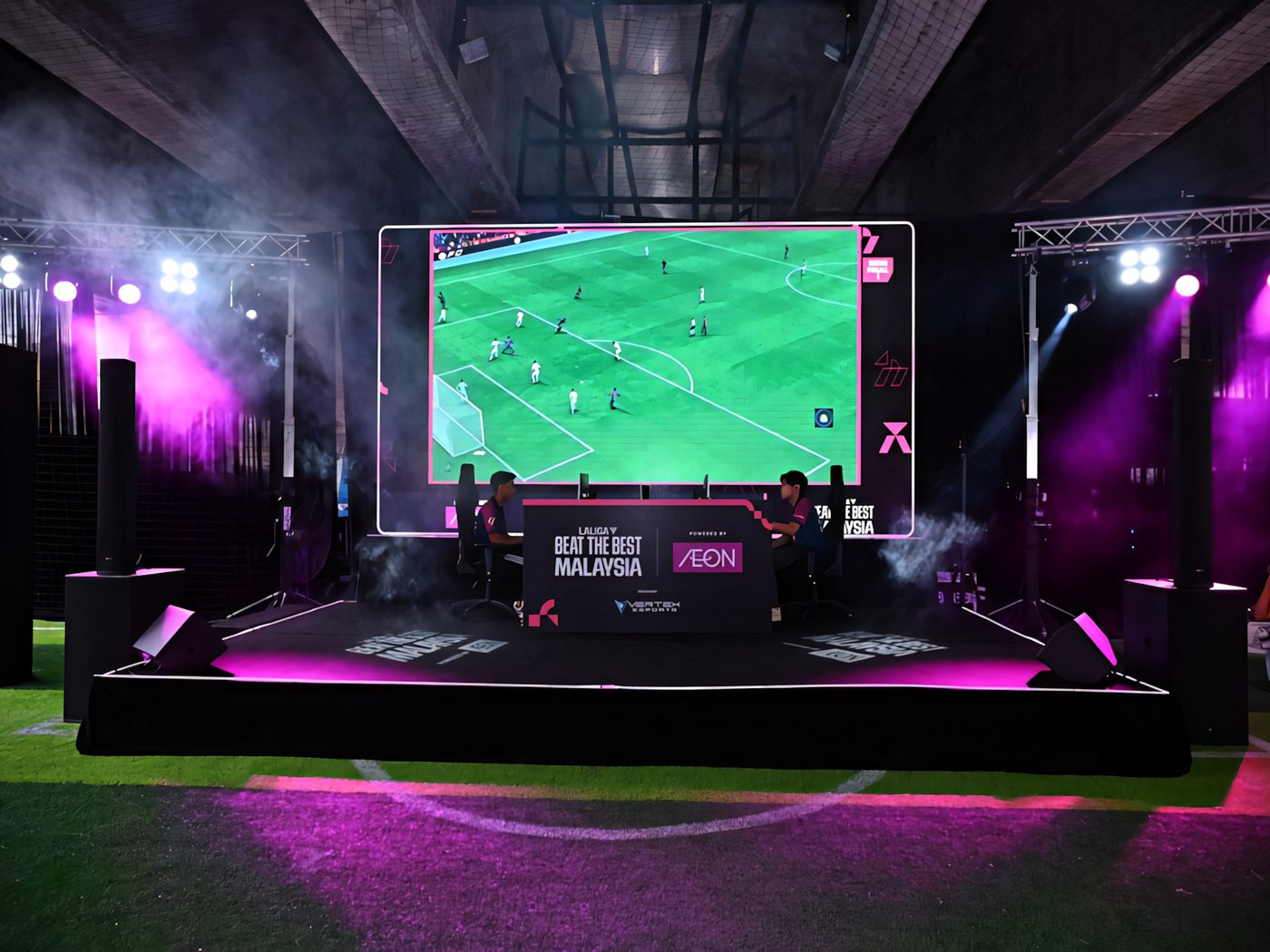
A league played in an empty room with no production value is still, technically, a league — but broadcast-grade production is what turns match day into content: camera operators, live casters, a creative director and a proper technical setup are what separate a competitive event people attend from one people actually watch, whether that's a handful of fans in the room or an audience watching the stream. As a point of reference, Vertex's own AEON-powered LALIGA Beat the Best Malaysia 2025 drew over 250 online participants competing for Top 16 slots and more than 2,000 attendees across activations at 1Utama and SP Sports Park — the kind of turnout that broadcast-quality production and a clear competitive format make possible.
Venue doesn't have to mean a dedicated arena
League match days can run in malls, esports centers and corporate spaces just as well as a purpose-built venue, provided the format, equipment and production plan are built around that location from day one rather than retrofitted later. A mall concourse with the right staging, screens and crowd-flow planning can host a league match day as effectively as a dedicated esports arena — it just needs to be planned as one from the start.
Frequently asked questions
What's the difference between a tournament and an esports league?
What does esports league management actually involve?
Do we need a broadcast setup to run a league?
Can a league run in a mall or esports center rather than a dedicated arena?
Thinking about running a league, not just a tournament?
Season formats, standings, scheduling and match-day broadcast production — run end to end, in malls, esports centers and corporate spaces.
Start a project